Thursday, July 1, 2010

Ultra Light Tackle for Sea Bass

Home port for me is the Manasquan River in Pt. Pleasant, New Jersey. My trusty center console sits in a slip in a small marina about quarter mile from the inlet so I can be in the ocean within minutes of slipping the lines.  From there I have access a variety of bottom and game fish species with the changing seasons that always keeps the fishing interesting.

One of my favorite types of fishing when I just want to relax and catch some fish for the table without working too hard is bottom fishing for fluke and sea bass, both tasty critters. They are also great fish to catch with children or people not too well versed in saltwater fishing. You can fish for them the old fashioned way using sinkers and bottom rigs, but a friend of mine; Tim Surgent – the owner of the popular fishing website Stripersonline.com – introduced me to an even more fun way to catch them a few years ago. He uses ultra light spinning tackle and bucktail jigs.

I remember the first time he showed up with a little freshwater spinning rod loaded with 6-lb test braided line and a box full of bucktails ranging from ¼ to 1-1/2 ounces. I was wondering just what he was going use them for since we would be anchored over a wreck in 75 feet of water fishing for black sea bass. Once we were anchored I took out what I considered light, a baitcasting outfit with 20-lb test Grand Slam Braid and a high-low bait rig with a 3 ounce sinker. As I was baiting up he slipped a strip of squid on the back of a small bucktail and dropped it straight down. When it hit the wreck he reeled up a foot or two and started wiggling the thing around and wham, the rod bent double as a fat sea bass engulfed the jig. It fought like crazy all the way to the surface, where Tim flipped the 3-pound beauty over the rail and into the cooler it went.

He not only out fished me and caught bigger fish to boot! He was having a ball, but little did he know I was sold and the next trip I would be packing a new 5’ ultra light spinning outfit loaded with 6 lb test Wildfire braid and all the small bucktails I had hanging around my tackle bench in the basement. I’ve been an addict ever since.
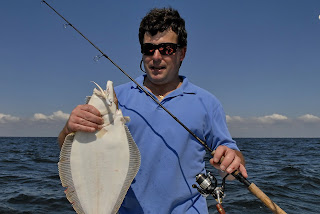

Some of the things I’ve learned since switching to the tiny tackle is that the super thin braid allows you to get very light jigs to the bottom and feel every twitch and piece of structure it touches. Use a stouter rod and heavier line and those small jigs would probably never make it that deep and would be difficult to feel. The bigger sea bass are aggressive predators and really go for the bucktails, which resemble baitfish. We definitely catch bigger sea bass, and sometimes bigger fluke, on these diminutive outfits and catching them is way more fun because they fight like crazy on the light rods instead of being overmatched by a more typical saltwater tackle.

If you fish for these tasty bottom fish try bringing along a freshwater ultra light outfit next time, but be sure it is filled with very light, very thin braided line. Four or six pound test Wildfire is perfect!

Caputi’s Blog Tip: Sweeten your bucktails. Bring along some squid cut into strips from 2 to 6 inches long. When using longer strips add a stinger hook to the bucktail so you don’t miss short striking fish. “Assist hooks” available at tackle stores make great stingers. 

-Gary Caputi

Thursday, June 24, 2010

Congratulations, Kim!

In between filming her TV Show “Breaking the Surface” on The Sportsmans Channel, Kim Bain-Moore found a chance to fish in the 25th Ladies Annual Fish-Off held in South Florida winning #1 Overall Angler. Kim, along with husband Andre Moore, also a member of the AFW/HI-SEAS Pro-Staff and their team “Crikey”, took 8th place overall. Congratulations Kim!

Monday, June 21, 2010

Why Wire Line - Part One

Trolling with wire line is a commonly misunderstood technique by the uninitiated. It is a wildly successful method of fishing for striped bass, bluefish and wahoo that is being rediscovered by a whole new generation of anglers.

First let’s clear the air a little. Trolling wire is not used to give the angler an unfair advantage and is usually lighter or equal in breaking strength to braid or monofilament line used for the same fish. It’s used to control the depth of the lures. The technique was developed over a hundred years ago to place trolled lures where the target predators spend most of their time, below the surface. For each ten feet of wire in the water the lure gains about one foot of additional depth. A lure will be running at about 20 feet with 200 feet of wire out; 30 feet for 300. This method is most popular for striped bass fishing although tournament wahoo fishermen use wire too, just for slightly different reasons.

A typical wire line outfit for inshore fishing for stripers and bluefish consists of a moderately sized conventional reel and a 7’ or longer trolling rod equipped with carboloy guides to handle the abrasive nature of the wire. The reel gets 200 to 300 yards of monofilament backing (50-lb test Grand Slam works great!) and then 300 feet of 40 or 50-lb test AFW Stainless Steel Trolling Wire or 40, 45 or 50-lb test AFW Monel Trolling Wire. The wire should be marked at intervals of 100’, 150’, 200’ and 250’.

If you’ve never fought a big striper or bluefish with a wire line outfit you don’t know how truly strong these fish are. The wire has zero stretch and you will feel every head shake, turn and hard-charging run of the fish. I’ve been striper fishing for over 25 years and one of the most memorable big striper days I have ever experienced was in November of 1991, when striped bass were scarcer than hen’s teeth, using wire and bunker spoons off Island Beach State Park in New Jersey. Me and my buddy, Joe Nunziato, caught 11 bass over 28-lbs including a 46, a 44, a 40 and several more in the high 30 lb class that morning! I’ve caught a few bigger fish in the years since, but that was a day to remember. Joe and I kept two biggest bass and released the rest and when the word got out we were the talk of the striper coast for weeks! In the early 90’s catching any bass was considered a victory, but this was simply unimaginable! Joe passed away after a very long and painful fight with lung cancer four years ago, but I will always remember him with a big smile as the photographer from The Fisherman magazine was taking our picture holding the two cows standing behind the console of my Mako.

With all the bass around today trolling bunker spoons, shad rigs and parachute jigs on wire line is more productive than ever and thousands of new anglers are rediscovering the joys of using wire line.  But enough for right now, we’ll get into trolling for wahoo with wire in a future blog. It’s high speed madness for a fish that is said to be one of the fastest creatures in the sea.

Caputi’s Blog Tip: Step-by-step instructions for marking wire line can be found on the AFW website or in their catalog, which you can download as a PDF file by clicking the link at the bottom of the home page. Then you can print it out for easy reference.

-Gary Caputi

Thursday, June 17, 2010

Big Striper Time!


If you live in the New York Bight area, central Jersey up through the western end of Long Island, the next four weeks are your greatest opportunity to catch a really big striped bass! A couple days ago a 57 pound monster fell to a wood plug cast from a boat off Island Beach State Park and the number of bass in the 30-lb. and up class in the area is staggering.

There are two reasons for this convergence and both have to do with spawning and migration patterns. The main body of fish that had been pouring into this area over the last couple months are mostly mature bass that were preparing to run 40 to 60-miles up the Hudson River to spawn, from the second week of May through the end of the month. Millions of bass make this annual migration and once they are done the run back down river into the waters surrounding the river mouth, they are ravenous and ready to rumble. As I write this, the earliest wave of spawners are coming out of the river while there are still more on the beds or heading that way.

The second wave of bass headed this way spawned in the Chesapeake Bay complex of feeder-rivers about a month ago. Afterward, they left the confines of the bay and started migrating north to their summering grounds off the coast of New England, feeding heavily as they go.

Both bodies of fish are about to collide in the New York Bight, which is currently choked with dense schools of menhaden (bunker) and other types of favored forage. From now through June and possibly well into July, the bass fishing is going to be monumental!

So how do you catch them? A few of my favorite ways are live lining bunker, fishing dead bunker on the bottom, casting big wood swimming plugs and poppers and trolling with wire line and bunker spoons. All work at various times so bring along the tackle for all of them so you’re ready for whatever conditions you might encounter.

Catching live bunker is easy with a cast net or by snagging them with weighted snag hooks. I live line with an outfit comprised of a wide spool baitcasting reel and a stout 7-foot graphite rod loaded with 30 pound Grand Slam monofilament or Grand Slam Braid. I use only the biggest circle hooks (9/0 or bigger) pinned through the nostrils of a live bunker with a 36” leader of Hi-Seas 100% Fluorocarbon in 50 or 60-lb test and a Mighty Mini Barrel Swivel. You can either swim the menhaden near the surface or replace the barrel swivel with a 3-Way swivel and sinker to get it deep or even right on the bottom.

Watch upcoming blogs on using plugs and trolling wire line for big stripers and remember, these are great game fish that deserve to be handled gently and released. Keep the small one for the table and let the biggest females go to spawn again.

-Gary Caputi

Monday, June 14, 2010

Can You Feel It?


It doesn’t matter if you’re fishing in freshwater or salt, many of the techniques we use to catch fish rely on the angler’s ability to “feel” what’s going on at the other end of the line.

I remember when I first started fishing plastic worms for largemouth bass. That was back in the day when there were only a couple companies’ even making plastic worms. I was using the best baitcasting reels and one of the first graphite rods blanks to come on the market. It had all the action of a pool cue, but man you could really stretch a fish’s neck with that sucker! A bass pretty much had to swim away with the worm to feel the bite because of the stretch in the monofilament line.

If I had the advantage of lines like HI-SEAS Wildfire, Grand Slam Braid or Quattro Fluorocarbon my hook-up ratio would have soared! These great new lines make feeling the bite so much easier. Wildfire and Grand Slam Braid have virtually no stretch so they transmit the most subtle sensations directly back to the angler’s hand. Quattro 100% Fluorocarbon has a small amount of stretch, but not enough to dampen the connection between the angler and the lure. It’s ideal for lures like plastic worms and finesse baits because it sinking more uniformly with the lure allowing you to maintain a tighter line as it is dropping. Tighter line means a more direct connection and the ability to feel and respond instantly.

The ability to “feel” isn’t exclusive to freshwater techniques. There are many techniques used in saltwater that benefit dramatically from using low stretch lines. Butterfly jigging for grouper or tuna is impossible without superbraid lines. With Grand Slam Braid and a high speed reel you can work lighter jigs deeper because the line is so thin and still feel every bite. Then a quick lift transmits all the energy and force of the rod into the hook set.

I enjoy bottom fish for a wide variety of species. Sometimes I use jigs or bucktails and other times I use bottom rigs and bait. Regardless, braided line makes feeling the most subtle bite and results in fewer missed opportunities. It makes filling the cooler with tasty fillets a lot easier.

Hi-Seas has the right line to match up with any fishing technique. Spend some time looking around www.hiseas.net and you’ll find the perfect line to make your fishing more productive, no matter what you are fishing for.

Caputi’s Blog Tip: For most applications a leader of fluorocarbon or monofilament is used with braided lines. When fish are being finicky and bites hard to come by try changing leaders. If you are using mono, switch to fluorocarbon to reduce visibility. If you are already using fluorocarbon switch to a lighter pound test.

-Gary Caputi

Thursday, June 10, 2010

Drag Racing


A lot is riding on the performance of the drag system of the reel when you’ve got a fish on the line. You can use the best line and terminal tackle and tie perfect knots, but if your drag is not performing correctly you will break fish off, especially big fish that test the limits of your tackle and angling skill.

The drag system on your reel works in much the same way as the brakes on your car. A combination of metallic and non-metallic disks rotates against one another to generate friction. The break pedal in your car controls the amount of pressure the brake pads place against the rotors and subsequently how hard the vehicle stops. A drag knob, star wheel or lever controls the pressure on the drag disks and how much force it will take for a fish to pull line off the reel. A drag system has to be smooth, adjustable and free of excessive start-up inertia—the need for greater force to get the disks to start slipping. If your reel is not up to these standards it should be serviced before your next fishing trip.

Setting a drag is best done with a drag scale. The typical drag setting is about one third of the breaking strength of the line for spinning and star drag reels. Set the drag with the line going through the rod guides, the end attached to a stationary object, tighten it a few turns and pump line from the reel against the drag, then reel back down. Do this at least a half dozen times to warm up the drag washers. Then attach the line to the drag scale and pull the rod and reel back with the rod tip pointed straight at the scale until the drag begins to slip. Check the scale for a reading and adjust the drag knob accordingly. Repeat the process until you get the desired setting.

Lever drag reels offer the option of changing the drag pressure during a fight and feature “strike” and “full” drag positions. Set strike at 30%, full at 50% and add one or two tape marks on the reel body for settings less than strike. That way you always know how much pressure you’re putting on a fish.

Drags are critical to fishing success. Be sure yours are at peak performance and you won’t be crying the blues when the big one breaks free.

-Gary Caputi

Thursday, May 27, 2010

National Championship

Recently I competed in the National Guard FLW College Fishing National Championship on Ft. Loudoun lake in Knoxville, TN- one of the biggest bass fishing tournaments of my entire career. With a first prize of $100,000, it was not something my partner Kevin and I were going to take lightly. Representing North Carolina State University's fishing team, we spent a large portion of the month prior to the event on the lake practicing and learning the lake. Thanks to some thorough homework, we were able to find some excellent areas that we really felt good about. We were catching fish on Strike King Flat Shad crankbaits in Chartruese/Black back using Hi-Seas Grand Slam 12lb monofilament. 


Come the first day of the tournament, one of our key areas was ruined by cold water runoff, but we were able to use a few of our backup spots to catch enough fish to put us in 7th place after day one, two spots away from making the top 5 cut which was made after day 2. Going in to Day two, with the same conditions, we hit the same areas that we caught our fish in the day before. Unfortunately, for some reason, the fish were just not eating right. We were able to hook up with several fish, but they quickly shook off- they were not eating it right. We tried other areas, adjusted the lure and color selection, but we could not buy a keeper bite! Unfortunately we were not able to put things together on day two, and did not make the top 5 cut. 


On Monday, the final day, instead of moping around about our poor performance on the prior day, I volunteered to take two soldiers fishing. I took them to the same exact areas that I fished the day before, and we WHACKED them! Both of the soldiers caught the biggest bass of their life- and I personally had 14lbs on my best 5 fish. The funny thing about it was that the biggest bag brought in by the final day competitors was only 10lbs. Its sad that we were not able to catch them on Day 2 like we did on Day 3, but I cannot complain about having a great time with two soldiers that deserved a great day on the water!


-Ben Dziwulski, collegiate angler from NC State University