Sunday, February 13, 2011

Bassmaster Classic


Well, another year is here and you know what that means….a new Bassmaster Classic champion will be crowned!  Our HI-SEAS pro-staff team is coming off a very successful 2010 campaign which kicked off with Jeff Kriet’s 2nd place finish on Lay Lake in Birmingham, AL.  We also had a solid 14th Place finish from Cliff Pace, and a 26th place finish from Terry Scroggins.  The 2010 Classic was also the debut of the first HI-SEAS wrapped boat on the B.A.S.S. Elite Series trail, run by Cliff Pace.  It was a very solid year for our Elite Team, capped off by Cliff Pace qualifying for his 2nd consecutive B.A.S.S. Angler of the Year Championship week in 3rd Place and ending the year 6th overall after the two tournament postseason.

The HI-SEAS Elite Series team of Cliff Pace, Jeff Connella, Jeff Kriet, and Terry Scroggins cashed an impressive 25 checks over the 2010 Elite season and Southern Opens combined. They racked up three 2nd-Place finishes, one 3rd-Place finish, and a total of ten Top 12 finishes. 

This year, we have 3 very strong competitors and favorites in Cliff Pace, Jeff Kriet, and Terry Scroggins. It should be another very exciting classic for HI-SEAS and our team!

As we have for the past 3 Bassmaster Classics, HI-SEAS will have an impressive booth set up at the Bassmaster Classic Outdoors Expo.  HI-SEAS will set up our display at the 2011 Classic Outdoors expo at the Ernest Morial Convention Center in Downtown New Orleans, LA.  As we have for the past 2 years, B.A.S.S. Elite Series Angler Jeff Connella will be available in the HI-SEAS booth ALL 3 days.  Jeff will be on hand to answer any questions you have about the HI-SEAS Lines, specific techniques, sign autographs, or to just talk fishing!  You will also get to meet the great people who work day in and day out to provide you with the highest-quality fishing lines available today.

Also, we are PROUD to have the legendary BILL DANCE on hand at our booth on Saturday, February 19th from 10am-11am!  Stop by and meet Bill, get his autograph, and say hello!  You DO NOT want to miss your chance to meet and talk to one of the legends of our sport!

We will also have some show-special pricing on ALL of our HI-SEAS Lines, sold through one our master retailers, Jann’s Netcraft.

Please stop by and see us at booth #2071, say hello to all of us, our Pros, and Bill Dance!  See you there!

Will Bellucci
Sales Executive – AFW / HI-SEAS

Thursday, December 23, 2010

Winter Sailfish Part Two: Dead Bait or Live


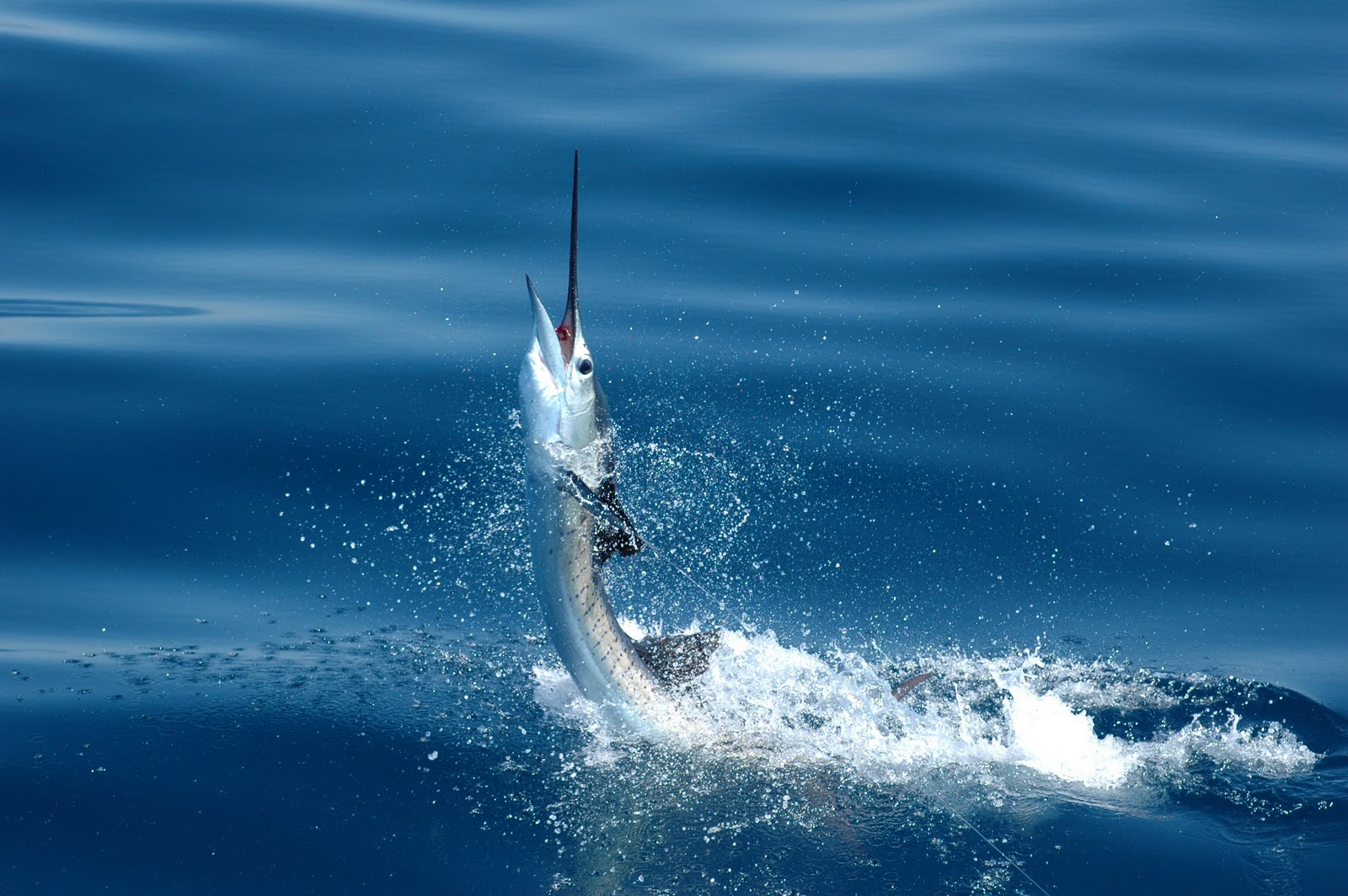
Sails are amazing acrobats
when hooked and fought.
Over the past few seasons Florida has experienced phenomenal winter runs of Atlantic sailfish. In fact, the season has gotten longer each year, as the population appears to be growing due to major regulatory action taken against pelagic long lining about ten years ago. With the long line fleet rapidly dwindling, and areas where their bycatch of sailfish and marlin was the highest closed to that gear the beneficiaries have been the stocks and anglers.

Live goggleye with a circle hook
in the nose for slow trolling.
While more people are fishing for sails, recreational fishing mortality is at an all time low with the advent of circle hooks and a stronger appreciation for these great billfish. The use of circle hooks has greatly reduced release mortality of both sailfish and white marlin, where the main techniques used for catching both is using either live or rigged dead baits. Circle hooks work by wrapping around the jaw structure of the fish so they are hooked in the corner of the mouth or on the bill. No damage to gills, stomach or throat, no bleeding, easy to remove, and away the fish swim — a little tired from the fight, but no worse for the encounter!
Loading up the live well with live
goggleyes for a days sailfishing.

Two techniques dominate fishing for sailfish — using live bait or trolling with rigged dead ballyhoo. Live bait is most popular from West Palm Beach south to the Florida Keys, with the prime baitfish being goggleyes and greenies, a species of sardine. Serious live bait fishermen use kites, but you can also slow troll a drift fish with live bait and even put them deep on downriggers. Personally I love kite fishing because it leads to savage strikes by aggressive fish right on the surface.
Dead ballyhoo rigged for trolling
with a circle hook.

A fishing kite is run out away from the boat with up to three release clips attached to it at various distances. A live baitfish is suspended from each release clip with the line run through a ring so the angler can control the baitfish from his vantage point on the boat. By letting line out or reeling up slack, he can keep the live bait splashing on the surface of the water, calling out to any sailfish in the area that there is an injured and easy prey item waiting to be eaten. Properly set up, a single angler can control two or three baits suspended from a single kite. When a sailfish pounces, the angler puts the reel in gear and winds slowly to pull the line out of the release clip, then winds like crazy to pick up the slack so the circle hook will wrap around the fish’s jaw.  
Launching a fishing kite. Note the
release clips on the line.

But you don’t have to go to the expense of buying kites, kite reels, rods and all the trimmings to fish live bait. I’ve spent many days fishing off the Florida coast drifting or slow trolling live bait. I even use a downrigger to get live bait down to deep feeding sails and there have been many days that the deep bait has caught the majority of the fish.

Competition trollers rely
on massive dredges as
teasers to attract sails
to their baits.
Trolling with rigged bait is a whole other ballgame. Small ballyhoo are rigged on circle hooks with small chin weights so they swim when trolled and fished using light lever drag reels and rods. Trolling is preferred by anglers north of the Palm Beach area because of the difference in near shore depth and structure. Sails in this area tend to spread out over larger areas, sometimes key on structure that accumulates baitfish. But just the rigged ballyhoo are frequently not enough to attract sails, so a subsurface teaser called a dredge is added to the trolling pattern as an attractor. A dredge is a six-arm wire frame with a couple dozen or more rigged ballyhoo or mullet, with no hooks, pulled behind it. It is dragged 20 to 50 feet behind the boat and weighted so it will run 10 to 20 feet down so it resembles a bait ball or school of baitfish. Tournament anglers use all natural baits on their dredges, but there are bait-free dredges available that are less time consuming and expensive to use that incorporate plastic imitation baitfish or strips of clear material with adhesive baitfish decals strung from them. They present a lot of flash in the water and can attract sailfish well, but if the sail attacks an artificial dredge it will not hang around long. The key is to get the approaching sailfish to switch off the dredge and eat one of the rigged ballyhoo being trolled nearby.
Most Atlantic sailfish are
in the 40 to 60 lb class
like this one, ideal for
light tackle.

Most serious sailfish guys use 20 pound test tackle because Atlantic sails rarely get much larger than 60 or 70 pounds. The vast majority are smaller, which makes them easy to handle on light line and a lot more fun. All the dedicated sailfish tournaments held in Florida during the winter require tackle no heavier than 20 pound test and mandate the use of circle hooks, too. Sails might be small compared to their larger cousins the striped, blue and black marlin, but they are very strong, extremely acrobatic and great fun to catch and release on the right tackle. If you’ve never done it, spend some time down south this winter and get in on the fun. I know I will.

Caputi Blog Tip:
Fluorocarbon leader is a must for sharp-eyed sailfish whether trolling or using live bait and there is none better than Hi-Seas 100% Fluorocarbon or Hi-Seas Quattro Fluorocarbon. Plan on using 60-pound test, which is plenty strong when paired with 20-pound test monofilament running line like Hi-Seas Grand Slam in Hi-Vis Yellow. Acceptable leader length varies from tournament to tournament so be sure to read the rules carefully and rig your tackle accordingly. 

Thursday, December 16, 2010

Winter Sailfish: Tournament Time


While December for northerners means it’s time to pull the boat and winterize it or hang up the waders for another season, for those lucky enough to live in sunny Florida it is the start of the winter sailfish season. There is no better time to catch these feisty billfish than December and January when the occasional cold front accompanied by Northeast winds cause them to gather in large schools and go on the hunt. Early winter finds them concentrated in the more northern reaches of Florida’s east coast, but as water temperatures drop and the bait they pursue pushes further south, so do the sailfish. The migration will take them into South Florida and the Keys.

For the past six years I’ve been the director of one of the oldest billfish tournaments in the United States, the Buccaneer Cup Sailfish Release Tournament, which has been run out of the West Palm Beach area each January for the past 47 years! Since I got involved it has been operated as a fund raising event for the Recreational Fishing Alliance (www.joinrfa.org), generating tens of thousands of dollars each year for the important work the organization does as the sole political action organization representing saltwater anglers. AFW/Hi-Seas is a corporate sponsor of the RFA and the Buccaneer Cup and we would certainly love to have you come fish with us this year.

Last year the fishing during the Buccaneer Cup was nothing short of incredible! In fact the number of sailfish caught hit an all-time high with more sailfish being released in the three days of fishing than at any other time during the events long history! The teams successfully caught and released a staggering 585 sailfish and saw hundreds more in massive schools stretching from Ft. Pierce to Jupiter Inlet. They experienced fishing so fast, both trolling with rigged baits and kite fishing with live bait, that teams were returning to the dock at day’s end exhausted and telling stories about how many more got away. Release flags were flying everywhere and it was a sight to see.

Why has the fishing for sails gotten so good? From my estimation it is the result of the work of the Recreational Fishing Alliance in forcing the government to close several key areas in the South Atlantic, Gulf of Mexico and the Straits of Florida to all commercial pelagic long line fishing. The problem with long line fishing is the gear not only catches and kills juvenile swordfish by the thousands, it also catches and kills sailfish and marlin as bycatch. The facts show that the number of sailfish being slaughtered by an out of control long line fleet was far in excess of anything the National Marine Fisheries Service thought at the time. In the 11 years since these regulations were put in place the sailfish population has grown rapidly to levels not seen in 50 years and the swordfish population has rebounded so successfully that there is a vibrant recreational fishery for them again up and down the East Coast.

There are two popular techniques for catching sails both for fun and in tournaments – live bait fishing with or without kites and trolling with rigged ballyhoo. We will take a closer look at both techniques in my next blog and pay special attention to easy ways you can get in on the fun without the expense of the techniques used by top tournament teams with unlimited budgets. So stay tuned.

Keep in mind that Atlantic sailfish are among the smallest billfish, and in Florida the average fish tends to be in the 40 to 60 lb range, so light tackle, both spinning and conventional, is all you need to enjoy the fight. The Buccaneer Cup prohibits line heavier than 20 lb. test during competition and sails are still caught and released in short order, usually after a spirited fight with lots of aerial acrobatics. They are truly a great sport fish to catch and the overwhelming number of anglers who pursue them releases every one they catch. They might make beautiful mounts for the wall, but all you need is a length measurement and any taxidermist can make you a fiberglass representation of your catch without ever seeing the fish.

If you are going to be in Florida this winter, here’s your chance to get in on one of the oldest and most prestigious billfish tournaments in the nation. Come fish the Buccaneer Cup with us by going to www.buccaneercup.com and singing up today. The dates are January 19 through 21 in sunny Florida, and if you don’t have a boat of your own that meets the requirements, there are plenty of boats available for charter for the event. We can help you with that, too. It’s for a great cause and if the action is anything like last year, the sails will run you ragged. 

Thursday, November 18, 2010

Fall Bass Guessing Game

The trees are bare and weather getting
chilly, but the bass are still biting.
Most of my earliest experiences fishing were chasing largemouth bass and, to a less degree, trout. At the time it wasn’t because I liked one more than the other, but there were a lot fewer trout waters available with walking or biking distance of home. As I fished more and got old enough to drive my fishing vistas opened more and my enthusiasm for bass fishing grew rapidly. My first boat was an aluminum car topper, then a larger aluminum boat on a trailer that was tricked out for bass fishing, then a real bass boat.

As my mobility on land and water expanded I became heavily involved in bass fishing both for fun and in tournaments in the Northeast. My first job out of college was in the public relations department of the largest tackle company in the U.S. at the time, which was headquartered in New Jersey. When the department head, a kindly older gentleman by the name of Dick Wolff, figured out I could bass fish and use a baitcasting reel proficiently, I became the “go to” guy to send for personal appearances at bass clubs and at some of the more high profile bass tournaments in the south, where B.A.S.S. was just starting to emerge as a force and Bass Pro Shop was still just a tiny store attached to Johnny Morris’ dads liquor store in Springfield, Missouri. I know about it because I bought my first spinnerbaits and Big O crankbaits there back in 1974 while attending a Bass Casters Association tournament on Lake of the Ozarks. It’s actually pretty funny when I think back on it and see just how bass fishing has evolved since.

Working a submerged weed bed
near a point drop-off is
a prime fall pattern.
My two favorite times of year on the bass fishing calendar were spring and fall, and if I had to choice between the two I would take fall every time! October, November and even December, depending on how far north you do your fishing, offers some of the finest bass fishing of the year as the quarry is generally feeding with abandon in preparation for the scarcity of winter. What makes it really interesting is the changing weather. Each new high or low pressure front that passes through changes the fishing conditions and forces the angler to use his brain to find where the barometric pressure has pushed the fish.

One rule of thumb we used was high pressure tends to drive them into deeper water and low pressure turns them on in shallow water. Just remember that deep and shallow are relative terms as the water temperatures get colder. Earlier in the fall shallow can put them in the weeds, especially weed beds close to deeper water. One of my favorite techniques for these conditions was ripping shallow running crankbaits along the edges of weed beds and watching the bass charge out of the cover to smash them. If they are father into the weeds try casting jig and pigs or Texas rigged worms into open spots in the weeds was often effective and even top water baits could produce fast fishing.

Comes the cold front, and they always do in the fall, and the bass move off to deeper structure and for a while become downright unresponsive to most lures. Try to find deep structure adjacent to shallow weed beds and check that out first. A creek bed, drop off or rock pile that is six to ten feet deeper will often be the first place the bass will fall back on. Change your tactics to smaller drop baits like finesse worms and shakyhead jigs and fish them so they fall slow and low. These techniques are deadly with Hi-Seas 100% Fluorocarbon line on the reel as it sinks in time with the light baits and has less stretch than mono so you can stay in touch with the bait better and pick up on subtle bites.

Don't forget to dress for fall fishing.
The weather can change quickly.
One technique we hit upon years ago that still works when bass are suspended over a deep drop off or other type of structure was drop fishing a Rattle Trap. The lures sink fast and can get into the zone easily, but it helps to know the rate of sink so you can count it down to the right level and then begin a slow to moderate retrieve. If you haven’t tried that one, especially late in the fall, you should. When we first started using that technique all we had was mono line. Now I prefer using Hi-Seas Wildfire fused braid for this because it is thinner and allows the plug to sink easily on a tight line, which gives it action as it falls. It also provides incredible sensitivity to the lightest strike and quick hook sets. I like to cast well beyond the structure, engage the reel and let the plug swim down in an arc back towards the boat. Many hits come as it swims its way down into the zone where the fish are holding before you ever have to turn the reel handle.

Be ready for fall this year with Hi-Seas lines on your favorite bass outfits. The right line for specific techniques can make you a more productive angler - and that’s a fact, Jack.


-Gary Caputi

Thursday, November 11, 2010

The Evolution of Terminal Tackle (part 2)

In the first part of our discussion on the evolution of terminal tackle we touched on advancements in wire leader materials and manufacturing. Keep in mind that while AFW Titanium Tooth Proof single strand and AFW Titanium Surfstrand braided leader are at the cutting edge of technology and performance there are many anglers who relay on the reliable performance of stainless steel leader products. The leading products in that category are AFW Tooth Proof single strand and AFW Surflon and AFW Surfstrand braided wires available in a number of configurations from 1 X 7 to 1 X 19 strands uncoated or nylon coated, to cover any fishing situation from the biggest sharks to the smallest fly fishing leaders. They even offer a wide selection of pre-packaged leaders with AFW Mighty Mini barrel swivels and snaps, which leads us to the next topic of discussion in the evolutionary development of barrel swivels and snap swivels.

The swivel became part of fishing when problems with line twist began to emerge. Many early fishing lures features parts that spun around a shaft or, in some cases, the entire lure would spin, which would cause the line to twist. After a while the twisting would become so severe that the line became unusuable. The problem was even worse prevalent in early monofilament lines, which kink up into a bloody mess when exposed to excess twisting. Early swivels were of the box variety consisting of a square open frame with wire loops that passed through holes in opposing ends of the square. While box swivels offered some relief from line twist they were not very efficient or effective and were followed by the earliest forms of barrel swivels, a shape common to almost anyone who fishes today. Early barrel swivels had to be large and bulky due to the crude manufacturing machinery of the time and to possess enough strength because they were formed out of soft brass.

The evolution of the barrel swivel was pushed forward by advances in manufacturing and the ability of the machinery to mass produce smaller and smaller metal components consistently, but materials lagged behind. Brass remained the material of choice because it was corrosion resistant and soft enough for the machinery of the day to form easily. So barrel swivels got smaller, but not too small because the remaining inhibiting factor was the brass itself. No matter how you cut it brass is still soft and it just isn’t very strong unless it is relatively thick.

The last inhibiting factor fell a few years ago when the machinery used for manufacture the component parts of a barrel swivel were improved to handle stronger materials, stainless steel in particular. Stainless steel maintains the corrosion resistant characteristics needed in terminal tackle and now machinery was in place that could manufacture and assemble the component parts to meet strict quality control standards using it. With that American Fishing Wire introduced the AFW Mighty Mini Series!

AFW Mighty Mini Crane Swivels are 100% stainless steel, both the rings and the bodies. These tiny wonders are three times stronger than brass or stainless/brass composite swivels and can be 3 times smaller than typical brass swivels. Whether you fish in fresh water or salt the smaller the rigging hardware at the end of the line the more natural the presentation of the lures or baits you are using. A more natural presentation means more bites and that’s the best news of all.

The smallest swivel in the AFW Mighty Mini line is the size of a 15 lb rated brass swivel, but it tests out to 78 lbs before failure. The strongest in the line is rated at 511 lbs of breaking strength, but smaller than a brass swivel rated at just 150 lbs. Now that’s remarkable, but you don’t have to believe me. Ask world famous big game angler, fishing tackle innovator and television personality Dennis Braid. He uses AFW Mighty Mini’s to tackle the biggest game fish in the world. Recently he caught one of the biggest fish ever landed on stand up tackle using his remarkable Braid belt and harness systems. He boated, tagged and released a 1047-pound giant bluefin tuna using size 1/0 Mighty Mini Crane Swivels in his bait rigs. Now that has to be the ultimate test of any terminal gear!

Stop fishing with old technology and step up to AFW Mighty Mini Swivels and Barrel Swivels. They best money can buy, and value priced too.

-Gary Caputi

Thursday, November 4, 2010

Albie Time!


Fall brings a cornucopia of great fishing opportunities and one of my favorites is the appearance close to the beach of a speed merchant called a Little Tunny. As I write this they are popping up blasting schools of baitfish from Long Island to North Carolina.

The Little Tunny is the smallest member of the Atlantic tuna family and while it resembles the Atlantic Bonito and Skipjack, those species are actually member of the mackerel family. Confused yet? Albies are easily identified by the dark spots appearing between the pectoral and ventral fins and "worm-like" markings on an olive colored back above highly reflective silver/white sides.  

Fat Albert has undergone a remarkable transition from trash fish to premiere light tackle game fish over the last 20 years. Trash because its flesh is almost inedible; game fish because they are strong and extremely fast. Anglers, especially fly fishermen, travel up and down the coast spending thousands of dollars to catch King Albert creating fishing destinations that were unheard of just a few short years ago like the Harkers Island area of North Carolina. There vast numbers of ablies congregate each fall. After I finish writing this blog I am packing my fly rods for a trip there to fish with renowned fly fishing guide Capt. Jake Jordan.

But you don’t have to go all over the place if you time their arrival in local waters. New England sees them enter Narragansett Bay and Vineyard Sound in September and they invade Long Island Sound shortly thereafter. The New York Bight arrivals move inshore in October and hang out into November depending on water temperature and bait availability. At the same time they show up off New Jersey they are appearing off North Carolina.

So how do you catch them when they show up? The most common place to find ablies on a tear is around inlets on the outgoing tide ambushing baitfish pouring out of estuaries, but find schools of small baitfish anywhere and they won’t be far away. I rarely have to go further than a couple miles from Manasquan Inlet to catch them locally.  

For tackle think light and stealthy because these fish have excellent eyesight. My favorite spinning outfit is a 7’ light/medium action graphite rod and freshwater size reel with an excellent drag system loaded with 6 to 10 lb. test Hi-Seas Grand Slam Braid or Hi-Seas Wildfire fused braid. I add a long (6’) leader of 20-lb. test Hi-Seas 100% Fluorocarbon for stealth. The lures are small metal jigs in the ½ to 1-1/2 ounce size, slender and very shiny to match the baitfish they are chasing. When I am lucky enough to be able to get a cast net over the school of spearing or bay anchovies before leaving the inlet I bring them along as chum to hold a school of ablies near the boat.

When ablies turn on catching them is easy. They will be blasting bait on the surface and you can cast to the splashing fish, let your jig sink a little and then start a moderate speed straight retrieve. When they hit, they smash the lure and take off at speeds that can reach 40 mph. When they stop showing on the surface watch your depth finder for straight line marks that indicate they are blasting through the sonar cone beneath the boat. If you see that make a long blind cast and let the jig sink to the bottom. Then start your retrieve. I’ve hooked as many albies blind casting as I have chasing the surface feeding fish.

If you can get them working a specific pod of baitfish hang with the bait and don’t go chasing other surface feeding fish. If you have it, throw handfuls of spearing in the water to keep the ablies nearby and make shorter casts. This is an ideal scenario for using the fly rod, which should be equipped with a light fluorocarbon leader, especially when the water is clear and tiny fish-shaped flies to emulate the batifish they are feeding on.

Fat Albert presents one of the fastest, and occasionally most frustrating, fishing opportunities of the fall season and one of my favorites. Keep an outfit ready for them regardless of what you are fishing for so you’re ready for the action when it starts. 

Thursday, October 28, 2010

Jigs & Shads for Fall Stripers


If you’ve read this blog for any period of time you probably picked up on the fact that I like fishing for striped bass. As a Jersey Shore guy, please no comparisons to Snooki and the casts of miscreants on the supposed reality show by the same name, striped bass are the premiere inshore game fish in my backyard, as they are for anglers from North Carolina to Maine. Fall is coming on fast with water temperatures plummeting and massive amounts of baitfish moving out of coastal rivers and bays. That means fishing the beach fronts should be fantastic for beach and boat anglers.

I took my center console out of Manasquan Inlet yesterday to chase false albacore and oceanic bonito and the concentration of bait in the river near the inlet was epic. The same goes for outside the inlet. Peanut bunker, mullet, bay anchovies, sand eels and spearing were everywhere and on the bottom below them were acres of small weakfish and spot picking them off. Bass love all of these forage species, including the weakfish and the spot, and you can match the hatch with a few simple lures and techniques.

The vanguard of bigger bass migrating south are not here yet, only the resident fish that remain in these waters throughout the summer, but they aren’t far away in distance or time. By early October we will be seeing large schools of stripers working their way south, stopping to feed voraciously along the way. The timing will be earlier to our north and later to our south, but you can count on it.

Two of my favorite methods of catching fall stripers are using light spinning tackle with plastic shads or using a medium bait casting outfit to vertical fish metal jigs. The two techniques don’t require a lot of specialized tackle, but I would not be caught dead without braid on both the spinning and bait casting outfits – Hi-Seas Grand Slam Braid or Hi-Seas Wildfire Fused Braid to be more precise. Why? Well the simple answer is they basically guarantee you’ll catch more fish. OK, it’s not a written guarantee, but using braid puts so many factors more squarely in your favor that you’d be crazy not to use the stuff.

Most of my spinning outfits for fall bass are 7’ graphite and rated as light/medium or medium with appropriately sized reels. They are spooled with 10 to 20-pound test Wildfire. Most of my bait casting outfits are 7’ straight-butt trigger sticks with medium or medium/heavy actions and appropriately sized reels loaded with 30 to 50-pound Grand Slam Braid.

The spinning rods are used mostly for throwing plastic shads or bucktails and Wildfire is the perfect line choice. Since it’s a Spectra line it has all the necessary benefits – thin diameter so the lures sink deeper more quickly, almost no stretch so you can feel even the lightest pick up, and its tough stuff. Fusing the outer sheath of the line gives it a rounder, smoother feel so it casts and spools beautifully on spinning reels and no special braid knots are necessary for tying on leaders.

I prefer Grand Slam Braid on the bait casting outfits because it is thinner than even the fused braid and I tend to use heavier line on these rigs. That’s because the metal jigs I fish below the boat are frequently heavier and larger, requiring a stiffer action rod to work them. I frequently fish jigs in deeper water right on the bottom, where stripers spend a good deal of their time, and big jigs can catch some big bass so the heavier tackle provides a better chance at boating a bigger fish. Grand Slam Braid is extremely thin, even in 30 and 50-lb test, and with almost no stretch you can feel the subtle pick up of a striper grabbing the jig while it is sinking to the bottom or when lifting and dropping it. It also gives you an advantage when setting the hook. A quick lift of the rod transmits all the power directly to the hook without losing any to line stretch.

The fall run in coming, the fall run is coming. Is your tackle rigged and ready for these two great fall striper techniques? It isn’t if the reels aren’t loaded with Hi-Seas Grand Slam Braid and Hi-Seas Wildfire lines.

Caputi’s Blog Tip: When fishing either braided line for fall stripers be sure to add a four or five foot leader of Hi-Seas 100% Fluorocarbon in 50 or 60 lb test as shock and chafe protections. Stripers might not have teeth, but they do have sand paper lined jaws. If bluefish are mixed in add a bite leader of AFW Surflon Micro Supreme. You can tie knots with it just like monofilament.